Wet vs Dry Cat Food Cost per 100 Calories
Compare wet and dry cat food costs with price per 100 kcal instead of bag size, can count, or serving-size claims.
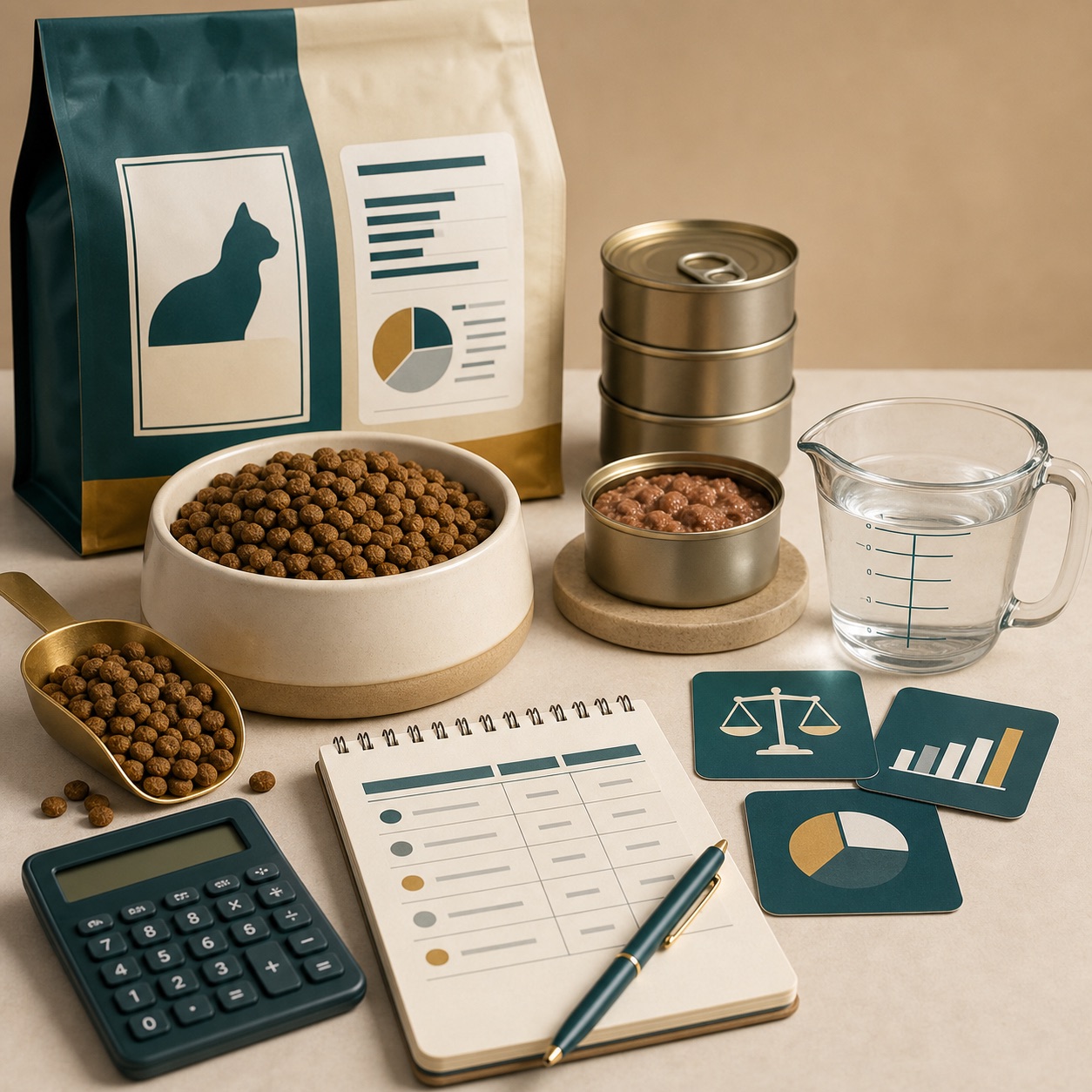
Use the formula first.
Wet and dry foods should be compared by calories and daily feeding target. Package size alone is a weak cost signal.
Formula
cost_per_100_kcal = package_price / total_package_kcal * 100
Use calories, not package size
Dry food, wet cans, pouches, freeze-dried foods, and toppers are sold in different package formats. A fair cost comparison needs a common denominator.
Price per 100 kcal is useful because cats eat energy, not packaging. It also helps avoid comparing a large low-calorie package against a small calorie-dense package.
A 16 lb bag, a 24-pack of 3 oz cans, and a 12-pack of pouches can all be legitimate food options, but their package units are not comparable. Converting each one to total package kcal creates the first fair comparison point.
Daily calorie targets are individual
Calorie needs depend on weight, body condition, age, neuter status, activity, and health context. CatCost uses label math and conservative budgeting language, not a medical feeding prescription.
Use your veterinarian's feeding advice or the food label as the primary input, then use the calculator to estimate the money side.
For budgeting, pick a daily kcal target and keep it consistent while comparing foods. If you change the target for one product and not another, the cost comparison will show a feeding-plan change rather than a product-value change.
Example dry food calculation
Suppose a dry food bag costs $28 and contains 28,000 kcal. The cost per 100 kcal is $28 / 28,000 x 100, or $0.10 per 100 kcal. At 240 kcal per day, that food costs about $0.24 per day and about $7.31 per average month.
That does not mean the food is right for every cat. It only means the package is cost-efficient on an energy basis. Suitability, feeding instructions, and veterinary context still matter.
Dry foods often look cheaper because they are calorie-dense and sold in larger bags. The $/100 kcal metric shows exactly how much of that advantage comes from calories rather than packaging.
Example wet food calculation
Suppose a 24-pack of wet food costs $24 and each can averages 95 kcal. The package contains 2,280 kcal, so the cost per 100 kcal is about $1.05. At 240 kcal per day, that is about $2.53 per day or $77 per month if it supplied all calories.
Many households do not feed 100% wet or 100% dry. If wet food supplies half the calories, use half the daily target for the wet calculation and half for the dry calculation, then add the two daily costs.
This is why can count alone can be misleading. A low price per can may still be expensive per calorie if each can contains fewer calories than a competing option.
How to calculate a mixed plan
If a cat eats 120 kcal from dry food and 120 kcal from wet food each day, calculate each food's cost per 100 kcal separately. Then multiply each by its share of daily calories.
This keeps wet food from looking like an add-on when it is actually part of the core monthly food budget.
The same logic works for toppers and treats, but they should be kept as separate budget lines unless they are nutritionally complete meals. Do not rank treats against complete food as if they served the same role.
What to verify on the label
Look for kcal per can, kcal per pouch, kcal per cup, kcal per kilogram, or kcal per package. If the label gives kcal per kilogram for a dry bag, multiply by the bag's weight in kilograms. If it gives kcal per can, multiply by can count.
When a variety pack contains multiple recipes, use the average kcal per unit or calculate each recipe separately if the counts are uneven. The goal is not false precision; the goal is a fair monthly estimate before purchase.
If Amazon or another retailer changes package count, flavor mix, or bag size, update the input before trusting the ranking.